

Employee Cost Calculator – Belgium [2026]
All-in-One Global Workforce Platform
Manage global hiring, compliance, and payments with a single platform built for clients, contractors.
Employee Cost Calculator Belgium: What a Hire Really Costs [2026]
Belgium is one of the most expensive places in Europe to employ someone and the headline salary hides most of it. Employer social security adds about a quarter on top of gross, and Belgian employees are paid close to 14 salaries a year once the 13th month and double holiday pay are counted. For a company hiring from abroad, these are the costs you can't see from the salary alone.
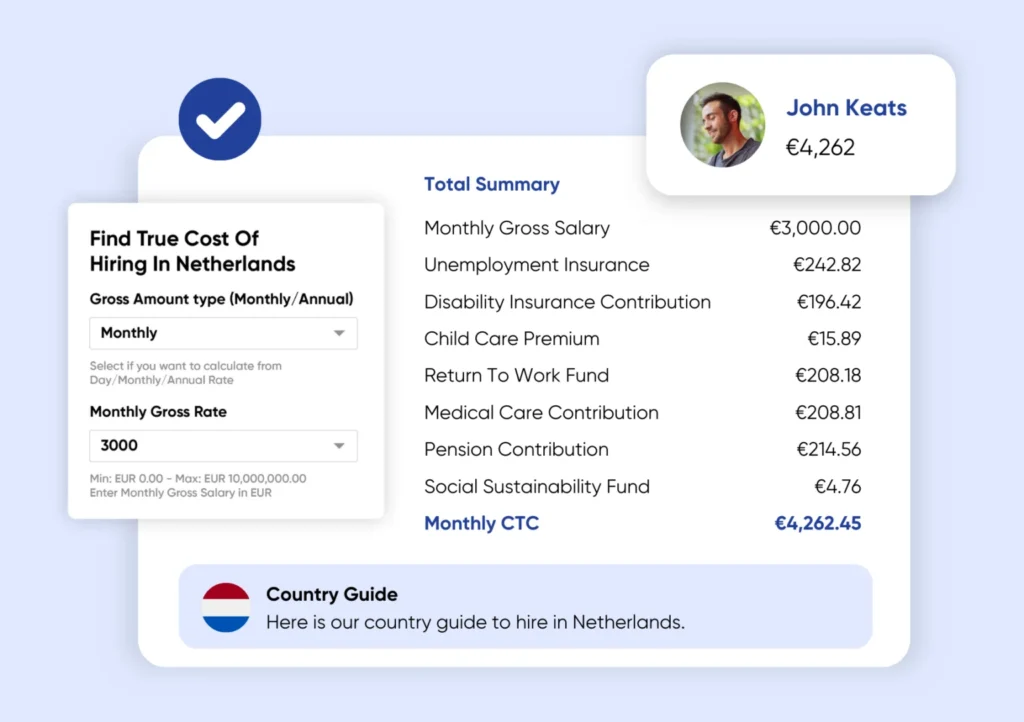
This calculator shows the real figure. Enter a gross monthly salary and you'll see the total employer cost, what the employee takes home, and where every euro goes. Below the tool, we break down each contribution with current 2026 rates, the Belgian extras, and a worked example.
The short answer: a Belgian hire costs ~25% above gross, ~45% above base pay
Two numbers matter. Employer social security adds about 25% on top of gross salary (up to ~27% with sector levies). But Belgium also pays a 13th month and double holiday pay, so the effective salary is about 13.92 months, not 12. Stack both and a €5,000 base role costs an employer around €7,263 a month, roughly 45% above base pay.
That 45% is why Belgium sits at the top of European employer-cost tables. The calculator above gives the exact figure for any salary.
What is an employee cost calculator for Belgium?
An employee cost calculator for Belgium works out the true employer cost of a hire, not just the salary, but RSZ/ONSS social security, the wage moderation contribution, sector levies, and the 13th month and double holiday pay on top; for broader employment planning, though, full employee cost can also include non-salary expenses like insurance, equipment, and administrative fees outside salary-linked payroll charges. It's also called an employer cost or cost-to-hire calculator.
It matters because Belgian payroll is unusually layered. Gross salary is only the start; the employer contributions and the extra salaries push the real cost far higher. A good calculator turns a monthly salary into a full annual employer cost so you can budget a Belgian hire accurately.
What goes into the cost of a Belgian employee (2026)
Employer social security (RSZ/ONSS)
Belgian employers pay social security contributions to the RSZ/ONSS, Belgium’s national social security system, on top of gross salary. For white-collar staff the basic employer contribution is 19.88% of gross (including the 13th month base). For blue collar workers, employer contributions are often calculated on an adjusted 108% base because of holiday pay structures. These contributions support healthcare, unemployment, family benefits, and disability, while employee withholdings help fund benefits covering pensions. Employers must remit these contributions on time to avoid penalties.
The wage moderation contribution (loonmatigingsbijdrage)
On top of the basic rate, employers pay a wage moderation contribution of 5.12%. Combined with the basic contribution, this makes up the 25% ordinary employer rate for white-collar employees. It's a distinctly Belgian line that generic calculators often miss and it's a quarter of your gross salary cost.
Sector, employer contributions, and special contributions
A few smaller contributions complete the employer picture: an extra 1.69% for employers with 10 or more staff, an asbestos fund (0.01%), a work-accidents special contribution (0.02%), and sector levies such as the closure fund and PC 200 sector fund (around 0.28% combined). Together these bring the all-in employer load to about 27% of gross — the figure usually quoted for Belgium, although sector-specific rules can also affect minimum wages, end-of-year bonuses, and other employment benefits beyond the standard contribution rates.
The 13th month and double holiday pay: Belgium's 13.92 salaries
The cost that catches every overseas employer: Belgian employees are paid more than 12 salaries a year. Most receive a 13th month (a year-end bonus roughly equal to a month's pay, often set by the sector agreement) and double holiday pay, an extra payment on top of normal salary when they take leave, worth close to a month. In practice, full time employees generally receive at least 20 days of paid annual leave. Belgium also has 10 official public holidays each year, which employers should factor into workforce planning.
Together these bring the effective total to about 13.92 salaries a year. So a €5,000 monthly base is really about €5,800 average monthly gross before any employer contribution. Social security is then charged on most of that, which is why Belgium's true cost runs so far above the headline salary. Your calculator applies this automatically.
Gross salary to net: what the employee takes home
Belgian employees see a large gap between gross and net. From gross, the following come off: employee social security (RSZ/ONSS) of 13.07% with no ceiling, a small special social security contribution (BBSZ), federal income tax on a progressive scale from 25% to 50%, and a communal (municipal) surcharge averaging about 7% of the income tax. On a €5,000 base, net pay is around €3,405 a month — about 59% of gross. The high tax and social security are the trade-off for Belgium's strong social safety net.
A worked example: the real cost of a €5,000/month hire
Here's how the cost builds for a white-collar employee on a €5,000 monthly base, using your calculator's 2026 figures; in this country, average salary levels vary by profession and region, so this is only one illustration. The gross reflects the 13.92-salary structure (~€5,800/month average).
Line | Amount (per month) |
|---|---|
Gross pay (13.92 salaries) | €5,800 |
Basic employer contribution (RSZ/ONSS, 19.88%) | +€1,077 |
Wage moderation (loonmatigingsbijdrage, 5.12%) | +€277 |
Contribution for employers with 10+ staff (1.69%) | +€92 |
Asbestos fund + work accidents (0.03%) | +€2 |
Other special / sector contributions (~0.28%) | +€15 |
Total employer cost | €7,263 |
For context, total annual employer cost averages around $74,655 per employee, though wages can still differ across sectors. That's 25.2% on top of gross, and about 45% above the €5,000 base pay once the 13th month and double holiday pay are included. The employee's net is roughly €3,405. Use the calculator for an exact figure by salary, communal rate and employer size.
Belgian benefits that add to the cost
Belgian compensation often includes tax-efficient benefits that sit on top of salary. Budget for the ones your offer includes.
Meal vouchers (maaltijdcheques)
Meal vouchers are near-universal in Belgium. The employer typically funds the larger share of a daily voucher (commonly up to around €6.91 face value, with the employer paying most of it), and they're socially and fiscally advantaged, cheaper than equivalent salary. Expect to offer them to stay competitive, with entitlement usually tied to actual working hours. Payroll cycles in Belgium are typically monthly, with payment on the last day, so meal-voucher budgeting is usually aligned to monthly payroll administration.
Company car vs mobility budget
Company cars are a long-standing Belgian norm, but the mobility budget is a growing alternative that lets employees trade a car for a flexible, more tax-favoured allowance (public transport, bike, housing costs near work). The two have very different cost and tax profiles, so model whichever you offer rather than assuming a car.
Supplementary (second-pillar) pension
Many Belgian employers offer a supplementary occupational pension (groepsverzekering / assurance-groupe) on top of the state pension. Employer contributions vary by scheme and sector, and carry their own social and tax treatment, a real cost line for competitive senior roles.
Hire Employees in Belgium with an Employer of Record [Guide]
Onboard and pay top employees and contractors in Belgium, without worrying about entities or compliance.

Employee cost in Belgium vs the UK, Germany and the Netherlands
Belgium is the most expensive of the major Western European markets to employ in, once the employer contributions and the extra salaries are counted. A rough comparison of employer on-costs above gross:
Market | Typical employer on-cost above gross | Distinctive feature |
|---|---|---|
Belgium | ~25–27% + the 13.92-salary structure | 13th month + double holiday pay; meal vouchers; company car/mobility budget |
Germany | ~22–23% | Pension, health, unemployment, care |
Netherlands | ~25% (incl. 8% holiday allowance) | 8% holiday allowance; 30% ruling |
United Kingdom | ~15–20% | Employer NIC (15%), pension (3%) |
Belgium's employer percentage is similar to the Netherlands', but the 13th month and double holiday pay push the all-in cost higher, which is why the "~45% above base pay" figure is the honest one to plan around.
Hiring in Belgium: EOR vs setting up an entity
To employ someone in Belgium, an overseas company either sets up a Belgian entity or hires through an Employer of Record. Belgium's payroll complexity, RSZ/ONSS, sector agreements (joint committees like PC 200), the 13th month, benefits makes the choice matter more than in lighter-touch markets.
Factor | EOR (PamGro) | Belgian entity |
|---|---|---|
Time to first hire | A few business days | Weeks to months (incorporation, RSZ/ONSS and tax registration) |
Setup cost | None | Notary, registration, legal and accounting fees |
Ongoing compliance | Managed by PamGro | Your responsibility — RSZ/ONSS, tax, sector rules, filings |
Sector agreement (joint committee) handling | Managed by PamGro | Your responsibility to apply the correct one |
Minimum headcount | 1 employee | Economical from a larger team |
Permanent establishment risk | Low — the EOR is the legal employer | Needs careful tax structuring |
Best for | Testing the market, speed, small teams | Large, long-term Belgian operations |
For most companies hiring their first people in Belgium, an EOR is faster and avoids the entity setup and the ongoing RSZ/ONSS and sector-agreement complexity.
Why overseas companies use PamGro to hire in Belgium
PamGro becomes the legal employer for your Belgian hires, so you onboard in days without a Belgian entity and we manage RSZ/ONSS, the wage moderation contribution, the 13th month and double holiday pay, the correct sector agreement, payroll and full compliance for a flat fee per employee.
The cost you model here is the cost you pay, with no hidden setup or offboarding charges. You hire and set the salary; we handle Belgium's social security and sector rules. [Speak to an expert] for a precise, salary-specific cost for your next Belgian hire.
10 Best EOR Companies in Belgium [2026]

Frequently Asked Questions
What are the total costs of employing someone in Belgium beyond salary?
Beyond gross salary, employers pay RSZ/ONSS social security of about 25% (up to ~27% with sector levies), plus the 13th month and double holiday pay, which raise the effective salary to about 13.92 months a year. Many offers also include meal vouchers, a company car or mobility budget, and a supplementary pension. Statutory pay floors and benefits depend on Belgian rules, including the statutory minimum wage and leave obligations. All-in, a Belgian hire often costs around 45% above base pay.
How do Belgian social security contributions impact the overall employer cost?
Employer social security (RSZ/ONSS) is the biggest add-on. For white-collar staff it's a basic 19.88% plus a 5.12% wage moderation contribution — a 25% ordinary rate — rising to about 27% with the 10+-staff contribution and sector levies. It's charged on gross, including the 13th month, so it scales with Belgium's higher effective salary count.
How do I calculate total employee cost including taxes and social security in Belgium?
Start with gross salary, apply the 13.92-salary structure (12 months + 13th month + double holiday pay), then add employer RSZ/ONSS (~25%) and sector levies for the total employer cost. As of 2026, Belgium's minimum wage is €2,112 gross per month, so no compliant calculation should go below that baseline. Income tax (25–50%), the communal surcharge and the employee's own 13.07% social security are deducted from the employee's pay, not added to employer cost. The calculator above does the employer side instantly.
How do I estimate gross to net salary for Belgian staff?
From gross, deduct employee social security (RSZ/ONSS 13.07%, no ceiling), a small special contribution (BBSZ), federal income tax (25–50% progressive) and the communal surcharge (about 7% of the tax). On a €5,000 base, net is roughly €3,405 — about 59% of gross. Actual net pay also depends on personal factors such as marital status and other tax variables. The gap is large because Belgium funds a comprehensive social system.
What are the specific employer costs for meal vouchers in Belgium?
Meal vouchers (maaltijdcheques) are a near-standard Belgian benefit. The employer funds most of each daily voucher (commonly up to around €6.91 face value, with a small employee share), and they're socially and fiscally advantaged — cheaper than paying the equivalent in salary. Budget for them per working day if your offer includes them.
What is the employer's contribution to supplementary pensions in Belgium?
Many Belgian employers offer a supplementary occupational pension (groepsverzekering / assurance-groupe) on top of the state pension. Employer contributions vary by scheme and sector agreement and have their own social and tax treatment. It's optional but common for competitive and senior roles, and it adds a real cost line on top of statutory contributions. Maternity leave lasts 15 weeks, with 82% salary for the first 30 days.
Can I use an employee cost calculator to estimate costs for Belgian freelancers?
Only partly. A freelancer (zelfstandige / indépendant) invoices you and pays their own social security and tax, so there's no employer RSZ/ONSS, 13th month or holiday pay. Unlike an employee in a regular job, freelancers work under a service arrangement rather than Belgian employment contracts. The headline is simpler, but day rates are higher and misclassification carries risk. For an ongoing role, an employee is usually safer; cross-border contractor compliance is what an Agent of Record handles.
Can a foreign company hire in Belgium without a Belgian entity?
Yes. A foreign company can employ staff in Belgium through an Employer of Record, which becomes the legal employer and handles RSZ/ONSS, the 13th month and double holiday pay, the correct sector agreement, payroll and compliance. Non-EU nationals may also need a work permit, while mobility within the European Union is generally simpler. This avoids setting up a Belgian entity and is usually faster and lower-risk for small or early Belgian teams.