
Employee Cost Calculator – Switzerland [2026]
All-in-One Global Workforce Platform
Manage global hiring, compliance, and payments with a single platform built for clients, contractors.
Employee Cost Calculator Switzerland: What a Hire Really Costs [2026]
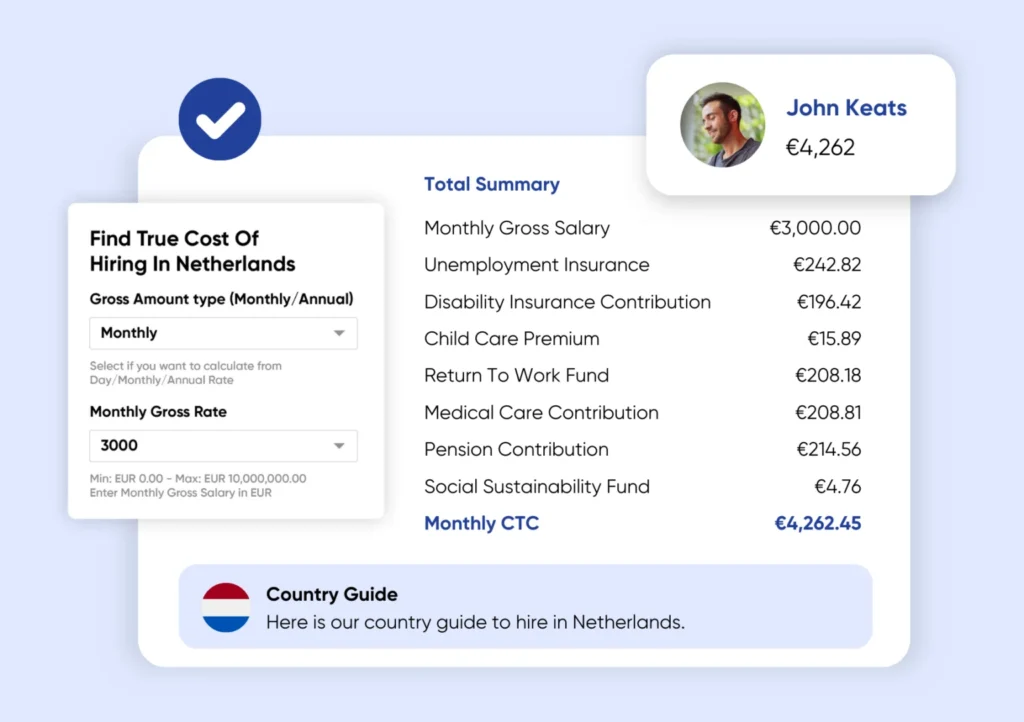
An employee cost calculator for Switzerland shows the full employer cost of a hire, not just gross salary: salary plus AHV/IV/EO, ALV, family allowance, accident insurance, BVG pension, and any canton-specific taxes or payroll variables. In most cases, that puts employer cost roughly 11-15% above gross salary, with the biggest swings coming from canton, pension band, and employee age.
Switzerland has the highest salaries in Europe but, surprisingly, one of the lowest employer on-cost percentages. There’s no heavy employer social security here. The real cost of a Swiss hire is driven by the salary itself, the employee’s pension, and the canton they work in, which is exactly why recruitment agencies, tech startups, SMEs, larger employers, and overseas companies hiring in Switzerland need a clear cost model before they budget or make an offer.
This calculator shows the real figure. Enter a gross salary, canton and a few details, and you’ll see the total employer cost, what the employee takes home, and where every franc goes. Below the tool, we break down the 2026 contribution rates, canton effects, BVG and withholding tax variables, a worked example, how Switzerland compares with other European hiring markets, and when it makes more sense to hire through an Employer of Record instead of setting up your own entity.
The short answer: a Swiss hire costs ~11–15% above gross salary
Employer contributions add only about 11% to 15% on top of gross salary in Switzerland — far less than Germany (~22%), Belgium (~27%) or the Netherlands (~25%). The reason: Swiss social insurance is modest and the occupational pension is split with the employee. On a CHF 120,000 salary in Zurich, the employer cost is around CHF 133,000 a year (about 10.9% above gross).
The trade-off is the salary level. Swiss pay is the highest in Europe, so a “cheap” 11% premium still sits on a very large base. Two things move the number most: the canton and the employee’s age (which sets the pension cost). The calculator above gives the exact figure.
What is an employee cost calculator for Switzerland?
An employee cost calculator for Switzerland works out the true employer cost of a hire — not just the salary, but AHV/IV/EO, unemployment insurance, the family allowance fund, accident insurance and the occupational pension on top. It's also called an employer cost or cost-to-hire calculator.
It matters because Swiss costs vary by canton and by employee age in ways a flat percentage can't capture. A good calculator turns a gross salary, a canton and an age band into a precise total employer cost — and shows the employee's take-home after withholding tax.
What statutory contributions go into the cost of a Swiss employee (2026)
AHV/IV/EO (old age, disability, income compensation)
The core Swiss social insurance. Employers pay 5.3% of gross (half of the 10.6% total) as part of their statutory contributions, covering old age insurance and survivors' pensions (AHV), disability insurance (IV), and loss-of-earnings compensation (EO). There is no salary ceiling, so it applies to the whole salary — which matters for Switzerland's high earners. Unlike many other European countries, AHV/IV/EO has no upper salary limit.
ALV (unemployment insurance)
Unemployment insurance costs the employer 1.1% of gross (half of 2.2%), up to a salary ceiling of CHF 148,200 a year. Above the ceiling, no further ALV is due, so it's a smaller share of cost for senior roles.
FAK (family allowance fund)
The family allowance fund is paid entirely by the employer and the rate is set by each canton, typically 1% to 3% of gross (around 1% in Zurich). Because it's cantonal, the same salary costs slightly different amounts in Zurich, Geneva or Zug.
Accident insurance (BU and NBU)
Occupational accident insurance (BU) is compulsory and paid by the employer — a small percentage set by the insurer and risk class (around 0.15% for office roles). Required insurance enrollment should be in place within the first payroll cycle. Non-occupational accident insurance (NBU) is legally the employee's cost, though some employers cover it. Both apply up to the CHF 148,200 ceiling. These accident and other mandatory benefits form part of Swiss employee benefits.
BVG occupational pension: the cost that rises with age
The BVG (second-pillar occupational pension) is part of Switzerland’s mandatory benefits and broader statutory benefits, and it works differently from other countries because it rises with the employee's age.
BVG is charged on the coordinated salary — annual salary capped at CHF 90,720, minus a coordination deduction of CHF 26,460, giving a maximum coordinated salary of CHF 64,260. Employees earning below the BVG entry threshold are not enrolled, while those above it join from the month they turn 25. The retirement credit on that amount rises by age band and is split 50/50 with the employee:
Age | Total credit | Employer share |
|---|---|---|
25–34 | 7% | 3.5% |
35–44 | 10% | 5.0% |
45–54 | 15% | 7.5% |
55–65 | 18% | 9.0% |
These are the minimum BVG contribution rates, so pension contributions vary by age bracket. So a 58-year-old costs noticeably more in pension than a 30-year-old on the same salary — the opposite of the ceiling effect elsewhere. These are legal minimums; many Swiss employers run more generous plans, and plans that cover salary above CHF 90,720 cost more again, with the employer required to enroll eligible staff in a pension fund.
The canton effect: why location changes the cost
Switzerland is federal, so several costs depend on the canton the employee works in: the FAK family allowance rate, cantonal and communal income tax, and the withholding tax tariff for foreign hires, and while there is no federal minimum wage, some cantons set their own rates. Geneva's minimum wage is CHF 24.48 per hour as of 2025. Depending on the sector, applicable collective bargaining agreements can set pay or terms above statutory minimums. Some collective bargaining agreements may also affect wage assumptions even where no cantonal minimum applies. The same CHF 120,000 salary can cost a different amount, and leave the employee with different net pay, in Zurich versus Geneva versus Zug. Always model the actual canton, the calculator does this.
Gross to net and withholding tax (Quellensteuer)
Swiss employees keep a high share of gross because social contributions and other statutory deductions are low. From gross pay, the employee pays AHV/IV/EO (5.3%), ALV (1.1%), the NBU accident premium, the BVG employee half, and these employee contributions reduce net salary before tax. For foreign nationals and other workers whose permit status means they do not hold a permanent residence permit, the employer deducts withholding tax (Quellensteuer) at source. The withholding rate is set by canton and tariff, and depends on gross salary, marital status, and children, so employers must apply the correct rate from the first payslip. Employers remit the amount monthly to the cantonal tax authority, and federal income tax is only one layer, topping out at 11.5% before cantonal and communal taxes are added. Swiss nationals and C-permit holders are taxed ordinarily instead. On a CHF 10,000 monthly gross, net pay is around CHF 7,883 — about 79% of gross, one of the highest take-home ratios in Europe.
A worked example: the real cost of a CHF 120,000 hire in Zurich
Here's a total employment cost breakdown for an employee aged 35–44 on CHF 120,000 a year (CHF 10,000/month) in Zurich, using your calculator's 2026 figures.
Component | Rate / basis | Monthly cost |
|---|---|---|
Gross salary | — | CHF 10,000 |
AHV/IV/EO | 5.3% | +CHF 530 |
ALV | 1.1% | +CHF 110 |
FAK (family allowance, Zurich) | ~1.025% | +CHF 103 |
Compensation fund admin | ~0.13% | +CHF 13 |
BU (occupational accident) | ~0.15% | +CHF 15 |
BVG (pension, age 35–44 employer half) | 5.0% of coordinated salary | +CHF 268 |
KTG (daily sickness, customary) | ~0.5% | +CHF 50 |
Total employer cost incl. statutory contributions | — | CHF 11,089 |
That's 10.9% on top of gross — modest in percentage terms, but on a CHF 120,000 salary it's still about CHF 13,000 a year. In practice, employers calculate these monthly charges on top of gross salary, while employee-side deductions are handled separately through Swiss payroll. The employee's net is around CHF 7,883. Use the calculator for an exact figure by canton, age and tax basis.
Employee cost in Switzerland vs the UK, Germany and Belgium
Switzerland is the outlier: the lowest employer on-cost percentage, on the highest salaries. A rough comparison of employer on-costs above gross:
Market | Typical employer on-cost above gross | Note |
|---|---|---|
Switzerland | ~11–15% | Lowest %, but Europe's highest salaries |
United Kingdom | ~15–20% | Employer NIC (15%), pension (3%) |
Germany | ~22–23% | Pension, health, unemployment, care |
Belgium | ~25–27% + the 13.92-salary structure | Highest all-in |
The low percentage is misleading on its own. A Swiss hire is still expensive because the salary base is so high — the modest employer premium just sits on a bigger number. Budget on the absolute figure, not the percentage.
Hiring in Switzerland: EOR vs setting up an entity
To employ someone in Switzerland, an overseas company either sets up a Swiss entity or hires through an Employer of Record. Switzerland's cantonal rules, mandatory pension (BVG) affiliation and withholding-tax administration make the compliance load real, even though the headline contributions are low. For companies entering the swiss market, an Employer of Record can be a more cost effective way to hire before committing to a local entity.
Factor | EOR (PamGro) | Swiss entity |
|---|---|---|
Time to first hire | 1 to 2 weeks | Weeks to months (incorporation, AHV and pension registration) |
Setup cost | None | Notary, capital, legal and accounting fees |
Ongoing compliance | Managed by PamGro | Your responsibility — AHV, BVG, accident, withholding, cantonal filings |
Cantonal + BVG setup | Handled by PamGro | Your responsibility to set up correctly |
Minimum headcount | 1 employee | Economical from a larger team |
Permanent establishment risk | Low — the EOR is the legal employer | Needs careful tax structuring |
Best for | Testing the market, speed, senior individual hires | Large, long-term Swiss operations |
EOR fees typically range from $199 to $599 per employee monthly.
For most companies hiring their first (often senior, well-paid) people in Switzerland, an EOR is faster and avoids the entity setup and the cantonal, pension and withholding administration. A Swiss entity may make more sense for larger, long-term operations, while an EOR suits first hires and market testing.
Why overseas companies use PamGro to hire foreign workers in Switzerland
PamGro has its own legal entity in Switzerland, so your hires are employed directly and compliantly — not through a third-party chain. We become the legal employer, handling AHV/IV/EO, ALV, the cantonal family allowance, BVG occupational pension, accident insurance, withholding tax, swiss payroll, statutory contributions, and employee benefits for a flat fee per employee.
PamGro supports swiss hires across onboarding, payroll, and compliance, including AHV registration before hiring.
The cost you model here is the cost you pay, with no hidden setup or offboarding charges. You hire and set the salary; we handle the Swiss social insurance, pension and cantonal rules, which helps you pay employees on time each month while managing the full payroll cycle compliantly. [Speak to an expert] for a precise, canton- and age-specific cost for your next Swiss hire.
Hire Employees in Belgium with an Employer of Record [Guide]
Onboard and pay top employees and contractors in Belgium, without worrying about entities or compliance.

10 Best EOR Companies in Belgium [2026]

Frequently Asked Questions
What are the essential components of total employee cost in Switzerland?
Total employee cost is gross salary plus employer contributions and mandatory benefits: AHV/IV/EO (5.3%), unemployment insurance (ALV, 1.1%), the cantonal family allowance fund (FAK, ~1–3%), occupational accident insurance (BU), the BVG occupational pension (age-based), and usually daily sickness insurance (KTG). Together these add about 11–15% to gross — low by European standards, but on Switzerland's high salaries.
How do Swiss social security contributions impact employer expenses?
Less than you might expect. The main employer contributions — AHV/IV/EO at 5.3% and ALV at 1.1% — are modest, and the occupational pension (BVG) is split 50/50 with the employee. Total employer contributions add only about 11–15% above gross, far below Germany or Belgium. The high cost of a Swiss hire comes from the salary level, not the contribution rate.
How do I calculate total employee cost including taxes and insurance in Switzerland?
Start with gross salary, then add employer AHV/IV/EO (5.3%), ALV (1.1%, up to CHF 148,200), the cantonal FAK, occupational accident insurance (BU) and the BVG pension (age-based, on the coordinated salary). Income tax is deducted from the employee via withholding (for foreign hires) and isn't an employer cost. The calculator above does the employer side by canton and age.
How does the BVG occupational pension affect employer cost in Switzerland?
BVG is the most variable employer cost, and it rises with age. It's charged on the coordinated salary (max CHF 64,260), with retirement credits of 7% (ages 25–34), 10% (35–44), 15% (45–54) and 18% (55+), split 50/50. So an older employee costs more in pension than a younger one on the same salary. Many employers also offer more generous plans.
What is withholding tax (Quellensteuer) and who pays it in Switzerland?
Quellensteuer is income tax deducted at source from foreign employees who don't hold a C permit. The rate depends on the canton, the tariff and the employee's situation (for example, around 10.6% at the Zurich A0 tariff). It's deducted from the employee's pay, and the employer remits it to the cantonal tax authority, so it's not an employer cost. Swiss nationals and C-permit holders are assessed through the ordinary tax return instead.
How do the cantons change the cost of a Swiss hire?
Switzerland is federal, so the family allowance fund rate, cantonal and communal income tax, and the withholding-tax tariff all vary by canton. The same salary can cost the employer a slightly different amount — and leave the employee with different net pay — in Zurich, Geneva or Zug. Always calculate for the actual canton of work.
How do sick leave and vacation days affect employee cost in Switzerland?
Swiss employees are entitled to at least four weeks of paid holiday a year, and employers must continue pay during illness for a period that increases with length of service (often covered by daily sickness insurance, KTG). These are built into salary rather than billed separately, but they raise the effective cost per working day. KTG premiums are a modest, customary add-on. Paid maternity leave is also mandatory at 14 weeks at 80% of salary, and Swiss National Day on 1 August is the federal public holiday, with others varying by canton.
Can a foreign company hire in Switzerland without a Swiss entity?
Yes. A foreign company can employ staff in Switzerland through an Employer of Record, which becomes the legal employer and handles AHV/IV/EO, the BVG pension, accident insurance, withholding tax and cantonal compliance. Compliant employment contracts must specify role, salary, and hours. Under Swiss law, employers must also include notice periods, typically 1 to 3 months depending on service length. PamGro has its own Swiss entity, so hires are employed directly and compliantly faster and lower-risk than setting up your own entity for small or senior Swiss teams.