

True Cost of Employee Calculator – Canada [2026]
All-in-One Global Workforce Platform
Manage global hiring, compliance, and payments with a single platform built for clients, contractors.
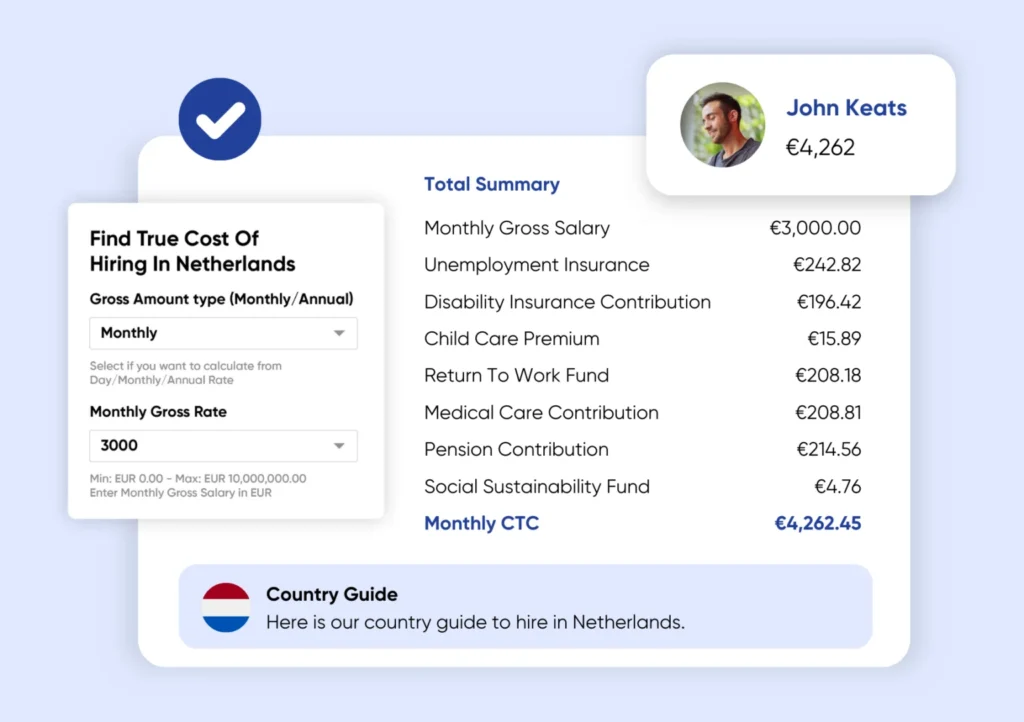
The salary you offer is not what the hire costs you. In Canada, the true cost of an employee usually runs about 10% to 15% above gross salary once you add mandatory employment-related costs — CPP, EI, workers' compensation and, in some provinces, an Employer Health Tax — and this calculator shows the exact 2026 employer cost by province before you commit.
Enter a salary and province, and you'll see the total employer cost, the burden rate, and where every dollar goes. Built for employers, recruiters, HR teams, agencies, startups, SMEs, and larger companies hiring in Canada, it helps you budget accurately, compare provinces, and avoid missing payroll obligations that can create compliance risk.
Below the tool, we break down each cost with current 2026 figures, a worked example, and the hidden costs most calculators skip. You'll also see how fully loaded employee cost changes once benefits and other non-payroll expenses are added, what legal compliance points affect hiring, and when it makes more sense to use an employer of record like PamGro instead of setting up your own Canadian entity.
How much does an employee really cost in Canada?
A Canadian employee costs roughly 10% to 15% more than their base salary once mandatory employment-related costs are added. On a $60,000 annual salary in Ontario, the total cost to the employer is about $65,500–$66,600 a year, depending on whether the Employer Health Tax applies and your workers' compensation class.
The largest components are CPP (5.95% employer match) and EI (2.282% employer rate). Workers' comp and provincial payroll taxes sit on top. The calculator above gives your exact cost of hiring for any salary and province.
What does MERCs mean in payroll?
MERCs stands for Mandatory Employment-Related Costs - the payroll contributions every Canadian employer is legally required to pay on top of an employee's salary. They include CPP, EI, workers' compensation premiums and, in some provinces, an Employer Health Tax. MERCs are the core of any true employee cost calculation in Canada, and they typically add 10–15% to gross salary.
How to use the Canada cost-to-hire calculator
Select the province where your employee will work, this sets the correct provincial taxes and workers' comp rate.
Choose the pay type like hourly, daily, weekly, biweekly, monthly or annually, which sets the pay period used for the estimate.
Enter the salary or wage you plan to offer.
Enter your details to receive the full breakdown.
Click Calculate to see your gross salary, CPP and CPP2, EI, workers' compensation, total employer contribution, employee payroll deductions, statutory deductions, and monthly cost to company (CTC).
Results update in real time for monthly or annual cycles, giving you a clearer view before running direct deposits. The estimate also reflects amounts employers must remit as statutory payroll deductions to the Canada Revenue Agency.
What's included in the true cost of an employee in Canada (2026)
When you hire in Canada, salary is only the starting point. Your total annual employer cost includes mandatory employer payroll taxes on top of gross wages, plus additional costs that can raise the full cost of employment. Every employer must make a set of mandatory contributions, the MERCs - that help fund government programs through CPP and EI. Here's each one with current 2026 figures.
Canada Pension Plan (CPP and CPP2)
Outside Quebec, employers contribute the same amount as employees to the Canada Pension Plan: 5.95% of pensionable earnings between the $3,500 basic exemption and the Year's Maximum Pensionable Earnings (YMPE) of $74,600. The maximum employer CPP contribution for 2026 is $4,230.45 per employee. On earnings between $74,600 and $85,000, a second tier (CPP2) adds 4%, up to a further $416 per employee. Some employers also budget separately for retirement plans beyond CPP, which is one of the mandatory contributions supporting retirement income.
Employment Insurance (EI)
Employers pay EI Premiums at 2.282% of insurable earnings - 1.4 times the employee rate of 1.63%. Maximum insurable earnings for 2026 are $68,900, making the maximum employer EI premium $1,572.30 per employee per year. Income Tax is withheld from employee pay and remitted by the employer, not added as a separate employer payroll tax, and withholding is based on Taxable Income under federal and provincial rules. If you want a quick estimate, an Online Calculator or Payroll Deductions Online Calculator can help, though payroll deductions can also be worked out manually. Quebec employers pay a reduced EI rate because QPIP covers parental benefits separately.
Workers' compensation
Workers' compensation is compulsory and set by each province's board: WSIB (Ontario), WorkSafeBC, CNESST (Quebec), WCB (Alberta). Premiums are a percentage of insurable payroll and depend on your industry's risk class, typically ranging from about 0.2% to 3.2%. A desk-based role sits near the bottom of that range.
Employer Health Tax and provincial payroll taxes
Canada also has additional payroll taxes at the provincial level, with Ontario’s Employer Health Tax (EHT) of 1.95% as a key example. Eligible employers under $5 million in payroll may claim the first $1 million Ontario payroll exemption. Below that threshold, you pay nothing, though these requirements vary based on province and payroll size. Manitoba, Quebec and some other provinces have their own payroll levies.
Quebec: QPP and QPIP
Quebec runs its own plans. Instead of CPP, employers pay Quebec Pension Plan (QPP) contributions at 6.40% in 2025, and all Quebec employers pay QPIP at 0.602% of insurable earnings toward parental leave. Quebec's EI rate is reduced because the province operates the Quebec Parental Insurance Plan. If you're hiring in Quebec, use the calculator's Quebec setting rather than federal rates.
What is the employee burden rate in Canada?
The employee burden rate is the total of all mandatory employer costs above gross salary, expressed as a percentage. It rolls CPP, EI, workers' compensation and any provincial payroll taxes into one number that tells you how much more expensive an employee is than their headline salary.
In Canada, the typical burden rate is 10% to 15% of gross salary, and it moves with four things:
Province - Ontario (EHT) and Quebec (QPIP, higher workers' comp) carry higher burden rates than Alberta or BC.
Industry - high-risk sectors like construction pay higher workers' comp premiums.
Payroll size - the Ontario EHT only applies above $1 million in payroll.
Salary level - CPP and EI are capped, so higher earners carry a lower effective burden rate.
Employee burden rate by province (2026)
In most provinces, the federal CPP and EI framework is the same, while workers' compensation and other provincial costs differ.
Cost factor | Ontario | British Columbia | Quebec | Alberta |
|---|---|---|---|---|
CPP / QPP (employer) | 5.95% | 5.95% | QPP (6.40%) | 5.95% |
EI (employer) | 2.282% | 2.282% | 1.82% (reduced) | 2.282% |
Workers' comp (avg) | ~1.2% (WSIB) | ~1.5% (WorkSafeBC) | ~1.8% (CNESST) | ~1.0% (WCB) |
Employer Health Tax | 1.95% (payroll >$1M) | EHT applies above threshold | Health Services Fund | None |
QPIP (employer) | — | — | 0.602% | — |
Typical burden above gross | ~10–13% | ~10–12% | ~13–16% |
|
Worked example: the true cost of a $60,000 hire in Ontario
Here's how the fully loaded cost builds for an employee on a $60,000 annual salary in Ontario, on 2026 figures and a ~1.2% WSIB class.
Cost component | Rate (2026) | Annual cost |
|---|---|---|
Gross salary | — | $60,000.00 |
Employer CPP | 5.95% on $56,500 | $3,361.75 |
Employer EI | 2.282% on $60,000 | $1,369.20 |
Workers' comp (WSIB) | ~1.2% | $720.00 |
Total (small employer, EHT-exempt) | — | $65,450.95 |
Employer Health Tax (if payroll >$1M) | 1.95% | +$1,170.00 |
Total (with EHT) | — | $66,620.95 |
So a $60,000 hire costs about $65,500 as a small employer (burden ~9.1%), rising to $66,600 once the Employer Health Tax applies (burden ~11%). The calculator above gives the exact figure for your province, industry and payroll size, though actual employer costs can vary based on industry class and payroll size.
How the burden rate changes with salary
CPP and EI are capped, so the burden rate falls as salary rises. These figures assume Ontario, a ~1.2% WSIB class, and that EHT applies.
Gross salary | Total MERCs added | Burden rate |
|---|---|---|
$40,000 | ~$4,345 | ~10.9% |
$60,000 | ~$6,621 | ~11.0% |
$80,000 | ~$8,539 | ~10.7% |
$120,000 | ~$9,999 | ~8.3% |
Above the CPP and EI ceilings, only workers' comp and EHT keep scaling, so the percentage burden drops for higher earners.
Fully loaded employee cost in Canada: what it means
The fully loaded cost is the full cost of an employee i.e gross salary plus every employer-side contribution and overhead. It goes beyond the statutory MERCs to include optional costs like benefits, paid time off, equipment and recruitment.
On a $60,000 Ontario salary, the statutory fully loaded cost is around $65,500–$66,600. Add health and dental benefits, vacation accrual, equipment and training, plus employer retirement contributions such as Group RRSP matching, and the real first-year cost is higher, often 20–30% above salary. "Fully loaded" is the number to budget with, not the headline salary.
Employee cost in Ontario: CPP, EI and EHT
Ontario is the most-searched province for employee cost, and it carries one extra cost many provinces don't: the Employer Health Tax.
For an Ontario hire, you pay the federal CPP (5.95%) and EI (2.282% employer) like everywhere else, plus WSIB workers' comp based on your industry class. On top, if your total Ontario payroll exceeds $1 million, you pay EHT at 1.95% on the amount above the exemption. Employers under $1 million in payroll are exempt. This matters when paying employees in Ontario, because province-level levies can also apply once payroll crosses the threshold. This is why the same hire can cost slightly more in Ontario because of Ontario-specific Additional Payroll Taxes, not just EHT.
Hidden costs most calculators miss
The MERCs above are mandatory. The costs that quietly inflate a hire are the ones no payroll formula captures:
Vacation pay - minimum 2 weeks, rising to 3+ with tenure (4% of wages, more over time).
Statutory holidays - 9 to 12 days depending on the province.
Health, dental, and disability insurance - typically $3,000–$6,000 per employee a year; not legally required but standard in competitive offers.
Recruitment - agency fees, job ads, and interviewing time.
Onboarding and equipment - laptop, software, setup.
Training and professional development - the salary runs while the hire gets productive.
These additional costs can add another 10–20% in the first year and raise overall employment costs. For a genuine all-in budget, plan for 25–35% above salary in year one, settling lower once one-off costs clear.
How remote work affects total employee cost
Remote work shifts cost rather than removing it. You save on office space and some overhead, but you may add a home-office or equipment allowance. Crucially, the employee's province of work, not your office location, determines their provincial payroll taxes and workers' comp, so costs vary based on where they work because provincial regulations and workers’ compensation rules differ.
A remote hire living in Ontario still triggers Ontario EHT rules once your payroll crosses the threshold, and their CPP and EI are federal regardless. So remote hiring changes which province's MERCs apply, not whether they apply, and that matters across Canadian provinces when employees are based in different jurisdictions.
Employee cost vs compensation package: the difference
These two are easy to confuse. A compensation package is what the employee receives like salary, bonus, benefits and perks. Employee cost is what the employer pays i.e the compensation package plus the mandatory employer contributions (CPP, EI, EHT, workers' comp) the employee never sees on their payslip.
The gap between the two is the burden rate. In Canada, total employee cost runs 10–15% above the compensation the employee actually takes home in value, because of these employer-side MERCs. Budgeting from the compensation package alone understates your real cost.
Legal requirements for employee benefits in Canada
Canadian employers must provide, at minimum: CPP and EI contributions, workers' compensation coverage, Paid Leave requirements including at least two weeks' paid vacation (increasing with tenure), statutory holiday pay, and the unpaid protected leaves set by each province's employment standards. Health and dental benefits are not federally required, but they're standard in competitive offers.
Exact entitlements, vacation accrual, holiday count, and leave rules vary by province under Provincial Regulations, so confirm against the relevant provincial employment standards before finalizing an offer. An Employer of Record handles these requirements for you, province by province.
Hiring in Canada: EOR vs setting up an entity
For a company based outside Canada, in the UK, Europe, India or the US, hiring in Canada raises one structural question: set up a local entity, or hire through an Employer of Record? An EOR lets a foreign company hire in Canada without incorporation, which is often the simplest route when you are bringing on your first employee there. Both are valid. The right answer depends on headcount, timeline and risk appetite.
Factor | EOR (PamGro) | Canadian entity |
|---|---|---|
Time to first hire | 3–7 business days | 6–12 weeks (incorporation, CRA + payroll setup) |
Setup cost | $0 — no incorporation | $2,000–$8,000 in legal and filing fees |
Monthly compliance cost | Flat fee per employee | $500–$1,500/month bookkeeping, payroll, T4 filing |
CPP, EI, WCB compliance | Managed by PamGro | Your responsibility |
Minimum headcount | 1 employee | Economical from 15–20+ |
Permanent establishment risk | Low — the EOR is the legal employer | Needs careful tax structuring |
Best for | Testing Canada, speed, teams under 20 | Large, long-term Canadian teams |
Below roughly 15–20 Canadian employees, an EOR is usually faster and cheaper once you count the setup, admin and compliance risk you avoid. Above that, your own entity starts to pay off.
Frequently Asked Questions
How much does it cost to hire an employee in Canada?
Total employer cost exceeds gross salary by 10–15%, depending on province and industry. Mandatory contributions include CPP at 5.95%, EI at 2.282% (employer), workers' compensation (0.2–3.2%), and the Employer Health Tax in Ontario (1.95% on payroll above $1 million). A $60,000 Ontario hire has a true employer cost of roughly $65,500–$66,600 a year.
What does MERCs mean in payroll?
MERCs stands for Mandatory Employment-Related Costs — the payroll contributions every Canadian employer must pay on top of salary. They include CPP, EI, workers' compensation, and provincial payroll taxes like Ontario's Employer Health Tax, and employers must remit statutory payroll deductions to the Canada Revenue Agency. MERCs typically add 10–15% to gross salary and are the foundation of any true employee cost calculation in Canada.
What is the employee burden rate in Canada?
The burden rate is the percentage of mandatory employer costs above gross salary — CPP, EI, workers' compensation and any provincial health or payroll taxes. The typical Canadian burden rate is 10–15%. It's higher in Ontario (EHT) and Quebec (QPIP) than in Alberta or BC, and lower for higher earners because CPP and EI are capped.
What is the employer CPP contribution rate for 2026?
For 2026, employers match employee CPP at 5.95% of pensionable earnings between the $3,500 basic exemption and the YMPE of $74,600. The maximum employer CPP contribution is $4,230.45 per employee. CPP2 adds 4% on earnings between $74,600 and $85,000, up to a further $416 per employee. (Source: CRA, 2026.)
What is the employer EI rate for 2026?
The employer EI rate for 2026 is 2.282% of insurable earnings — 1.4 times the employee rate of 1.63%. Maximum insurable earnings are $68,900, making the maximum employer EI premium $1,572.30 per employee. Quebec employers pay a reduced rate because QPIP covers parental benefits separately. (Source: CRA, 2026.)
Does an employer have to pay workers' compensation in Canada?
Yes. Most Canadian employers must register with their provincial board and pay premiums based on insurable payroll and industry risk class. Rates vary: Ontario (WSIB) ~1.2%, BC (WorkSafeBC) ~1.5%, Quebec (CNESST) ~1.8%, Alberta (WCB) ~1.0%. Some industries and self-employed individuals may qualify for exemptions — check with your provincial board.
What is the Employer Health Tax (EHT) in Ontario?
Ontario's EHT is a payroll tax of 1.95% on total Ontario payroll above the $1 million exemption, available to employers under $5 million in payroll. Employers below the threshold are exempt. EHT funds provincial healthcare and is remitted to the Ontario Ministry of Finance, separate from federal CPP and EI. Manitoba and some other provinces have similar levies.
What are the main components of employee cost in Canada?
Total employee cost has three layers: gross salary; mandatory employment-related costs (CPP, EI, workers' compensation, and provincial payroll taxes like Ontario EHT); and discretionary costs such as benefits, extra vacation, equipment and training. The mandatory layer adds 10–15%; benefits and setup push the fully loaded figure higher.