

Employee Cost Calculator – Poland [2026]

All-in-One Global Workforce Platform
Manage global hiring, compliance, and payments with a single platform built for clients, contractors.
Employee Cost Calculator Poland: What a Hire Really Costs [2026]
An 8,000 PLN salary doesn't cost you 8,000 PLN. Employer ZUS contributions and PPK add about a fifth on top of gross pay. For a company hiring from abroad without a Polish entity, these contributions are the part you can't see from the salary alone.
This calculator shows the real figure. Enter a gross salary and you'll see the total employer cost, what the employee takes home, and where every złoty goes. Below the tool, we break down each contribution with current 2026 rates, the income tax brackets, how contract type changes the cost, and a worked example.
The short answer: a Polish employee costs about 20% more than gross
An employee cost calculator for Poland works out the true employer cost of a hire, not just the salary, but every mandatory ZUS contribution and PPK on top. It's also called a cost-to-hire or cost-to-company calculator.
It matters because gross salary is only part of the bill. Polish employers pay social insurance contributions to ZUS (pension, disability, accident, Labour Fund and the Guaranteed Employee Benefits Fund) and, for enrolled staff, PPK. A good calculator turns a salary into a full employer cost so you can budget a Polish hire accurately.
What goes into the cost of a Polish employee (2026)
Employer ZUS contributions
Every Polish employer pays social insurance (ZUS) on top of gross salary. For 2026:
Contribution | Employer rate |
|---|---|
Pension (emerytalne) | 9.76% |
Disability (rentowe) | 6.50% |
Accident (wypadkowe) | ~1.67% (0.67–3.33% by sector) |
Labour + Solidarity Fund (FP + FS) | 2.45% |
Guaranteed Employee Benefits Fund (FGŚP) | 0.10% |
Total employer ZUS | ~20.48% |
These social security contributions rates are set by the Ministry of Family, Labour and Social Policy, and accident insurance is not uniform for every employer because it depends on the payer, even though simple estimates often use about 1.67%.
Pension and disability contributions are capped at an annual base of PLN 282,600, so they stop accruing above that threshold.
PPK (Employee Capital Plans)
PPK is Poland's workplace savings scheme. Employers contribute a mandatory 1.5% of gross (and may add up to 2.5% voluntarily). Employees are auto-enrolled but can opt out. Where the employee stays in, PPK adds 1.5% to your cost so an employment contract with PPK runs about 22% above gross.
What the employee pays (ZUS, health, PIT)
From the employee's side, deductions are taken from gross: employee ZUS of 13.71% (pension 9.76%, disability 1.50%, sickness 2.45%), health insurance (NFZ) of 9% of the base after ZUS, and income tax (PIT). These reduce take-home pay but aren't employer costs, they're useful for explaining the gap between gross and net.
Income tax in Poland (PIT): the 2026 brackets
Personal income tax in Poland is 12% on annual income up to 120,000 PLN, and 32% on income above that. There's a tax-free amount of 30,000 PLN a year (applied in payroll as a 300 PLN monthly reduction when the employee has filed a PIT-2). A 4% solidarity levy applies only to income above 1,000,000 PLN a year, so it affects very few employees.
PIT is deducted from the employee's pay, not an employer cost but the employer calculates and remits it, and it's the main reason take-home is lower than gross.
Contract type changes the cost: umowa o pracę vs zlecenie vs B2B
Poland is unusual in how much the contract type changes the cost. This is the single most important variable for budgeting a Polish hire:
Umowa o pracę (employment contract): full ZUS and PPK apply, so the employer load is about 20–22% above gross. Full labour-law protection for the employee, including annual leave / paid leave of 20–26 days of leave per year depending on length of service; that cost is already built into the regular monthly salary, so you should not add it separately to the total employer cost.
Umowa zlecenie (mandate contract): a civil-law contract with reduced or partial ZUS depending on the person’s circumstances, often cheaper, but with fewer protections and specific rules.
B2B (self-employed contractor): the worker invoices you and pays their own ZUS and tax, so there’s no employer ZUS. Common for IT roles, but misclassification carries risk if the relationship looks like employment.
For a stable, ongoing role, an employment contract is the safe default. For genuine project or contractor work, zlecenie or B2B can cost less but weigh the compliance risk. Cross-border contractor arrangements are what an Agent of Record handles.
A worked example: the real cost of an 8,000 PLN hire
Here's how the cost builds for an employee on 8,000 PLN gross a month, on a full employment contract with PPK, at 2026 rates.
Component | Rate | Monthly cost |
|---|---|---|
Gross salary | — | 8,000.00 PLN |
Pension (emerytalne) | 9.76% | 780.80 PLN |
Disability (rentowe) | 6.50% | 520.00 PLN |
Accident (wypadkowe) | 1.67% | 133.60 PLN |
Labour + Solidarity Fund | 2.45% | 196.00 PLN |
FGŚP | 0.10% | 8.00 PLN |
PPK (employer) | 1.5% | 120.00 PLN |
Total employer cost | — | ~9,758.40 PLN |
That's about 22% above gross with PPK, or ~20.5% (9,638.40 PLN) without it. The employee's take-home is lower again, after their own ZUS (13.71%), health (9%) and PIT. Use the calculator above for an exact figure by salary and contract type.
The 2026 minimum wage and its cost
The Polish minimum wage for 2026 is 4,806 PLN gross a month. With employer ZUS on top, the minimum-wage employee costs an employer roughly 5,790 PLN a month (about 20% above gross), before PPK. If you're budgeting entry-level or support roles, this is the floor.
What a calculator won't show you
The figures above are the statutory employer costs. A fully loaded budget should also account for sick leave funded by the employer at 80% of pay for the first 33 days of incapacity in a calendar year, with that limit resetting each calendar year. A fully loaded budget also includes recruitment, onboarding and equipment, training, occupational-health examinations and BHP training, benefits (private healthcare and Multisport cards are common in Poland), and payroll and compliance admin as additional employment costs. For a true first-year cost, plan above the statutory figure.
Hire Employees in Poland with an Employer of Record [Guide]
Onboard and pay top employees and contractors in Poland, without worrying about entities or compliance.
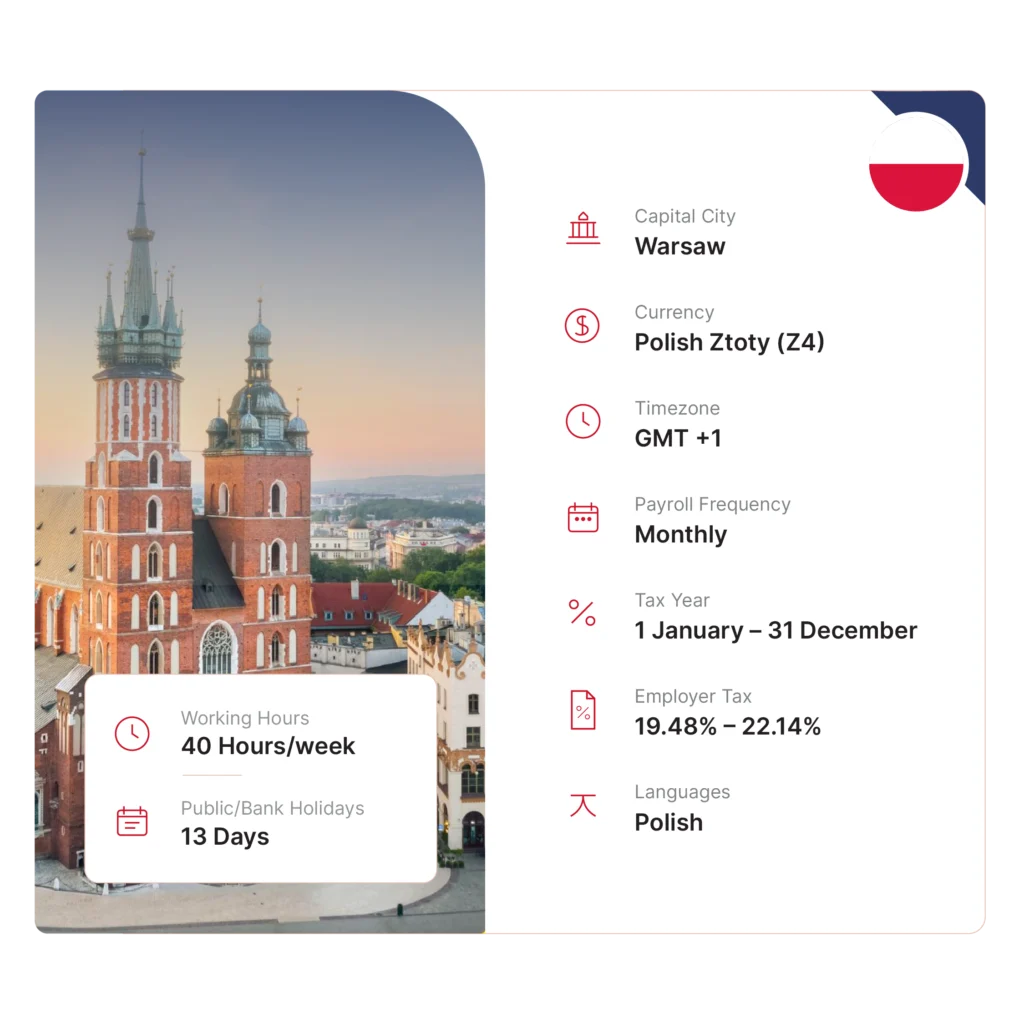
Employee cost in Poland vs the UK and Germany
Poland's employer social-contribution load is moderate by European standards and salaries are typically lower which is why Poland is a leading nearshoring and IT destination. A rough comparison of employer on-costs above gross:
Market | Typical employer on-cost above gross | Main components |
|---|---|---|
Poland | ~20–22% | ZUS (pension, disability, accident, funds), PPK |
United Kingdom | ~15–20% | Employer NIC (15%), pension (3%) |
Germany | ~22–23% | Pension, health, unemployment, care |
The employer percentage is similar to Germany's, but Poland's lower salary base usually makes the absolute cost of a hire meaningfully lower - a key reason companies build teams there.
Hiring in Poland: EOR vs setting up a sp. z o.o.
To employ someone in Poland, an overseas company either sets up a Polish entity (usually a sp. z o.o.) or hires through an Employer of Record. Both are valid; the right answer depends on headcount and timeline.
Factor | EOR (PamGro) | Polish entity (sp. z o.o.) |
|---|---|---|
Time to first hire | A few business days | Weeks to months (incorporation, ZUS and tax registration) |
Setup cost | None | Notary, registration, legal and accounting fees |
Ongoing compliance | Managed by PamGro | Your responsibility - ZUS, PIT, PPK, filings; each employee must be registered with ZUS within 7 days of the start date |
Minimum headcount | 1 employee | Economical from a larger team |
Permanent establishment risk | Low - the EOR is the legal employer | Needs careful tax structuring |
Best for | Testing the market, speed, small teams | Large, long-term Polish operations |
For most companies hiring their first people in Poland, an EOR is faster and avoids the entity setup and ongoing ZUS/PPK compliance. That matters because these are tasks employers are required to handle when hiring in Poland directly.
Why overseas companies use PamGro to hire in Poland
PamGro becomes the legal employer for your Polish hires, so you onboard in days without a sp. z o.o. and we manage ZUS, PPK, PIT, payroll and full compliance for a flat fee per employee. We also handle the contract-type decision (employment vs mandate vs B2B) so the arrangement is compliant from day one.
The cost you model here is the cost you pay, with no hidden setup or offboarding charges. You hire and set the salary; we handle the Polish social security and compliance. [Speak to an expert] for a precise, salary- and contract-specific cost for your next Polish hire.
10 Best EOR Companies in Poland [2026]

FAQs
What are the mandatory employer contributions for a full-time employee in Poland?
On a full employment contract, employers pay ZUS social insurance on top of gross salary: pension (9.76%), disability (6.50%), accident (~1.67%), the Labour and Solidarity Fund (2.45%) and the Guaranteed Employee Benefits Fund (0.10%) — about 20.48% in total. Where the employee stays in PPK, add 1.5%, bringing the employer load to roughly 22% above gross.
How do I calculate total employee cost including taxes and insurance in Poland?
Start with gross salary and add employer ZUS (~20.48%) and PPK (1.5% if enrolled) for the total employer cost — about 20–22% above gross. Income tax (PIT, 12% up to 120,000 PLN) and the employee's own ZUS and health insurance are deducted from the employee's pay, not added to employer cost. The calculator above does the employer side instantly.
How much does it cost to hire an employee in Poland?
Budget about 20–22% above gross salary on a full employment contract. An 8,000 PLN monthly salary costs an employer roughly 9,640 PLN (ZUS only) to 9,760 PLN (with PPK). A minimum-wage employee (4,806 PLN in 2026) costs around 5,790 PLN. Add recruitment, equipment and benefits for a full first-year budget.
Does the cost change for contract vs full-time employees in Poland?
Yes, significantly. A full employment contract (umowa o pracę) carries full ZUS and PPK — about 20–22% above gross. A mandate contract (umowa zlecenie) often has reduced ZUS depending on the person's situation, and a B2B contractor pays their own ZUS and tax, so there's no employer contribution. Contract type is the biggest cost variable in Poland, but misclassifying B2B as disguised employment carries risk.
What are the 2026 income tax (PIT) rates in Poland?
Polish personal income tax is 12% on annual income up to 120,000 PLN and 32% above that, with a tax-free amount of 30,000 PLN a year. A 4% solidarity levy applies only to income above 1,000,000 PLN. PIT is deducted from the employee's salary; the employer calculates and remits it but doesn't bear it as a cost.
What is PPK and does the employer have to pay it?
PPK (Pracownicze Plany Kapitałowe) is Poland's workplace retirement savings scheme. Employers must contribute a mandatory 1.5% of gross salary, and may add up to 2.5% voluntarily. Employees are auto-enrolled but can opt out. If the employee stays enrolled, PPK adds 1.5% to your employer cost on top of ZUS.
What are the legal requirements for reporting employee costs in Poland?
Employers must register employees with ZUS, calculate and remit monthly ZUS and PPK contributions, withhold and pay PIT advances to the tax office, and file the required ZUS declarations (such as DRA) each month. Deadlines and formats are strict. An Employer of Record handles all of this, which is why many overseas companies use one rather than build Polish payroll in-house.
Can a foreign company hire in Poland without a Polish entity?
Yes. A foreign company can employ staff in Poland through an Employer of Record, which becomes the legal employer and handles ZUS, PPK, PIT, payroll and compliance. This avoids setting up a sp. z o.o. and is usually faster and lower-risk for small or early Polish teams — and it covers the contract-type decision correctly from the start.