
Hiring in Sweden with an Employer Of Record
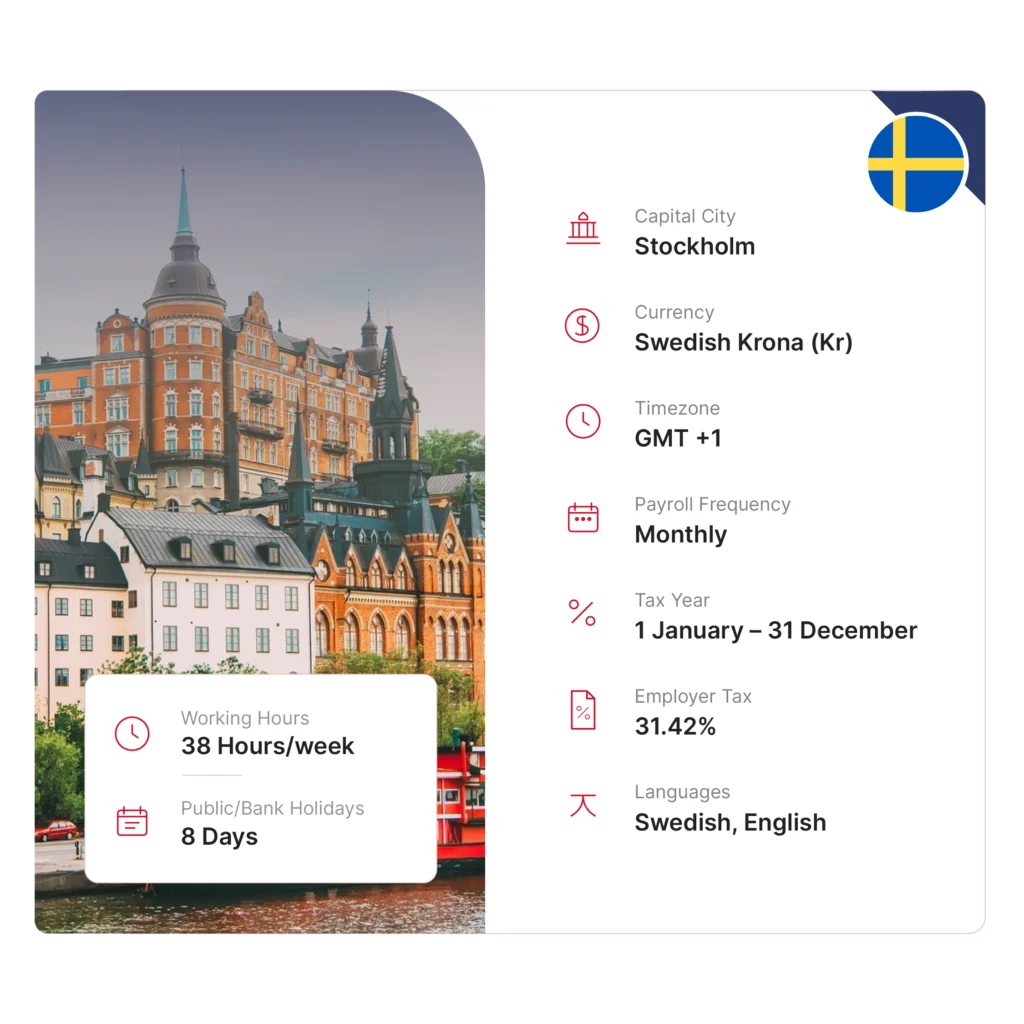
Employer of Record in Sweden
What is an Employer of Record Services in Sweden?
Hiring directly in Sweden requires you to form your own legal entity, register with authorities, administer payroll filings, and ensure full compliance with local employment regulations. This process delays hiring and diverts resources from core business operations.
Using an employer of record services in sweden lets you:
- Hire employees legally without opening a Swedish entity
- Onboard talent in days instead of months
- Stay compliant with strict Swedish employment laws and local laws
- Offload complex HR and payroll tasks
- Reduce expansion costs, timelines, and operational risk
How does the Employer of Record Process Work for Sweden-based Employees?
The EOR model is built for companies that want the benefits of hiring in Sweden without navigating the legal complexities of Swedish labour law. An Employer of Record (EOR) like PamGro takes on both administrative responsibilities and employment responsibilities on behalf of the client, managing payroll, taxes, benefits, and onboarding. Sweden’s regulatory environment makes structured, compliant employment essential.
With a sweden employer of record like PamGro, the employment structure works like this:
How to choose the Best Employer of Record Provider for Hiring in Sweden?
Selecting the right EOR partner is critical, because they become the legal employer for your Swedish team. A strong EOR enhances trust, employee experience, and compliance, while the wrong one exposes your business to risk.
Here’s a refined framework to help identify the best employer of record companies in sweden:
1. Assess your hiring goals
Define the roles, team size, contract type, benefits expectations, and compliance requirements, considering the process of hiring workers, including international employees, and the importance of proper worker classification. Different EORs specialise in different hiring models.
2. Confirm that the provider has true operational capability in Sweden
PamGro’s employment framework ensures compliance management for hiring without reliance on fragmented third-party structures.
This helps prevent:
- Slow onboarding
- Miscommunication
- Compliance gaps
3. Evaluate the employee experience
A good Swedish EOR should offer:
- Smooth onboarding
- Timely salary payments
- Clear employment documentation
- Local HR support
- Responsive communication
This shapes how employees perceive your brand, even though PamGro handles the legal side.
4. Review compensation & benefits capabilities
Your EOR should help you build market-aligned salary structures, taking into account the employee’s gross salary as the basis for calculating social security contributions and taxes, manage benefits compliantly, and provide data-backed insights to stay competitive.
In Sweden, there is no national minimum wage. Instead, minimum wage levels are typically set by collective bargaining agreements within different industries, which effectively serve as industry-specific minimum wages.
5. Prioritise security, compliance, and transparency
Strong data protection, GDPR alignment, and compliance monitoring including ensuring adherence to several labor laws and local labour laws in Sweden, such as regulations on employment contracts, working conditions, wage protections, and employee rights—are non-negotiable in Sweden.
6. Finalise and start hiring
Once partnered with PamGro, your team can immediately begin onboarding Swedish employees through a seamless workflow.
If you want to compare leading providers, you can explore this helpful guide: Top Employer of Record Companies Sweden.
Key Things to Know About Hiring in Sweden
1. There’s no national minimum wage
Sweden doesn’t set a statutory minimum wage. Instead, industry-specific unions negotiate collective bargaining agreements that define minimum salary levels, working hours, and overtime pay. While not technically mandatory, most employers follow them as a baseline.
2. Employment agreements are a legal must
If someone in Sweden works for your company for over three weeks, you must provide a written employment contract. It should clearly state the job title, responsibilities, start date, working hours, gross salary in SEK, probationary period, and notice period. Fixed-term contracts automatically become indefinite if they last beyond two years.
3. Overtime is capped and must be compensated
Sweden enforces a 40-hour workweek. The law doesn’t mandate premium pay for overtime, but many collective agreements offer a 50–100% higher rate of pay for overtime hours. Legal caps limit overtime to 48 hours over four weeks or 50 hours per month, with a yearly cap of 200 hours.
Sweden’s workplace norms emphasize balance. Labor laws require daily and weekly rest periods and protect time off. Remote work is common, but the culture encourages boundaries and supports the employee’s right to disconnect.
4. Employers fund key benefits
Employers contribute 31.42% of each worker’s gross salary toward payroll taxes, which fund benefits like pensions, social insurance, and healthcare. Sweden has no centralized HR system, but compliance expectations are high, especially regarding government-backed worker benefits.
5. Termination requires a clear process
In Sweden, termination rules are strict. Employers must provide valid reasons and follow the terms of the employment contract or the relevant collective agreement. Notice periods range from one month to six months depending on tenure and collective agreements. Swedish employers aren’t legally required to provide severance pay, but they may offer it through a collective agreement or a negotiated departure. Employers must also provide notice pay for the full duration of the notice period.
Hiring in Sweden
Employment Contracts & Agreements in Sweden
Swedish law requires employment contracts that clearly outline job duties, compensation, work conditions, leave structure, and termination processes. Although contracts can be oral, a written contract is a legal requirement in Sweden for any employment lasting longer than three weeks, ensuring compliance and clarity of the employment relationship.
Key points include:
- Sweden employment contracts are generally categorized as indefinite, fixed-term, or for seasonal or temporary roles, each with specific legal requirements and contractual provisions
- Contracts default to indefinite unless explicitly fixed-term
- Fixed-term contracts exceeding 2 years convert automatically to permanent
- Seasonal or temporary roles are typically considered fixed-term and may require distinct terms in the contract
- CBAs may define additional terms such as salary brackets or overtime rules
Labour Law Compliance in Sweden
Sweden’s employment framework is governed by multiple laws designed to protect workers’ rights and ensure fair treatment. These include:
- Employment Protection Act
- Annual Leave Act
- Work Environment Act
- Paternal Leave Act
- Working Hours Act
- Discrimination Act
Swedish Employment Law Overview (LAS)
Sweden’s employment landscape is governed primarily by the Employment Protection Act (LAS), which outlines rules for hiring, notice periods, probation, and termination. LAS emphasises job security and requires employers to follow structured, legally compliant procedures throughout the employment lifecycle.
Key principles under LAS include:
- Employment defaults to permanent unless explicitly stated otherwise
- Probation periods typically last up to six months
- Terminations must be objectively justified, either due to redundancy or personal reasons
- Notice periods increase with tenure and may be further defined by collective agreements
Understanding Collective Bargaining Agreements (CBAs) in Sweden
Collective bargaining agreements (CBAs) play a central role in the Swedish labour market. Nearly 90% of Swedish employees are covered by some form of CBA, either through a union or through industry-level agreements.
CBAs may define:
- Minimum salary levels
- Overtime pay structures
- Additional leave entitlements
- Pension contributions
- Working hour rules
- Termination procedures
These agreements often supersede statutory requirements and must be followed even if the employer is not directly part of the union system. PamGro ensures compliance with all relevant CBAs for your industry so that employment terms remain fair, competitive, and legally sound.
Hire the Best Talent, Anywhere
Onboard and pay top employees and contractors globally, without worrying about entities or compliance.
Get started
Taxes
Employer Taxes: 31.42%(estimated)
★ 3.55% – Health Insurance
★ 2.6% – Parental Insurance
★ 10.21% – Retirement Pension
★ 0.6% – Survivors Pension
★ 2.64% – Labor Market Fee
★ 0.2% – Occupational Injury
★ 11.62% – General Payroll Tax
Employee Tax: 37%-62%
Income up to SEK 613,900 is taxed at 0%, and income over SEK 613,900 is taxed at 20% via the Progressive National Income Tax. The Municipal Income Tax is 32%.
Employee Benefits & Compensation
Salary & Overtime
- Average salary: 46,000 SEK/month (varies widely by industry)
- Overtime: 150–200% of hourly wage
Not typically included (varies by provider): group health insurance premiums, gratuity insurance, background verification, immigration/visa support for foreign nationals, equity management.
Benefits Typically Offered
Along with mandatory protections like paid leave and sick pay, employers often offer:
- Pension supplements
- Wellness allowances
- Dental and vision plans
- Flexible work options
- Additional paid leave
- Life and accident insurance
Severance in California
California law does not require severance pay, though it may be offered at the employer’s discretion.
Work Permits and Visas for Employees in Sweden
Hiring foreign nationals in Sweden requires the right work authorization before employment begins. Sweden’s immigration rules are strict, and employers must ensure every non-EU/EEA employee has a valid work permit issued by the Swedish Migration Agency (Migrationsverket). When hiring through PamGro’s employer of record in sweden solution, this process becomes simpler because PamGro acts as the legal employer and prepares all required employment documentation.
Foreign employees generally need a Work Permit (Arbetstillstånd) based on a formal job offer that meets Swedish standards for salary, benefits, and working conditions. These terms must align with Swedish labour laws and, where applicable, collective bargaining agreements.
Hire the Best Talent, Anywhere
Onboard and pay top employees and contractors globally, without worrying about entities or compliance.
Get Started