

Hiring in Poland with an Employer Of Record
Employer of Record in Poland
What is an Employer of Record service in Poland?
An employer of record (EOR) is a third-party organization that legally employs workers on behalf of another company. The EOR manages employment-related responsibilities such as onboarding, payroll, tax withholding, statutory benefits, and compliance with Polish labor laws and local employment laws.
By partnering with an EOR, companies gain an employment partner that supports them in hiring employees in Poland without establishing a local legal entity or navigating complex regulatory requirements.
How to hire employees in Poland using an Employer of Record?
Hiring through an EOR in Poland follows a structured, step-by-step hiring process designed to ensure compliance while minimizing administrative burden.
The EOR manages recruitment, onboarding, payroll, and HR administration, handling all necessary documentation and background checks. This approach streamlines operations for companies expanding into Poland, as the EOR assumes responsibility for employment contracts, tax withholdings, and compliance with EU and Polish employment regulations, including local employment regulations.
Step #1: Decide between an Employer of Record and a local legal entity
Before hiring in Poland, companies must decide whether to establish their own Polish legal entity or partner with an EOR. The right choice depends on available resources, long-term expansion plans, and internal compliance capabilities.
Setting up a legal entity in Poland Establishing a Polish entity typically requires registration with local authorities, including the National Court Register (KRS), opening a Polish bank account, and engaging local legal and tax advisors. Employers must comply with Polish labor law, tax regulations, and social security requirements overseen by the Social Insurance Institution (ZUS). Errors or delays in setup can significantly slow hiring timelines.
Hiring through an Employer of Record An EOR acts as the legal employer on your behalf, eliminating the need to form a local entity. Through an EOR, companies can hire full-time employees in Poland while ensuring compliance with EU and Polish employment regulations. EOR services typically include payroll processing, tax withholding, benefits administration, contract management, and employee onboarding.
Step #2: How to choose the right EOR for Poland hires
When selecting an Employer of Record for Poland, consider the following criteria:
- Is the EOR active in Poland and other countries where you plan to hire?
- Does the EOR own its legal entities, or does it rely on third-party partners?
- How does the EOR protect sensitive employee and company data?
- Does the EOR offer automated onboarding, payroll, and benefits workflows?
- What level of local expertise and customer support does the EOR provide?
A reliable EOR should combine local regulatory knowledge with secure, scalable technology.
Why companies choose PamGro
PamGro enables companies to manage a global workforce from a single platform, localize onboarding processes, and maintain compliance across jurisdictions.
Step #3: How to hire and onboard employees in Poland?
Once an EOR is selected, onboarding begins with collecting required employee information, including:
- Full legal name
- Date of birth and start date
- Residential address in Poland
- PESEL (personal identification number)
- NIP (tax identification number)
- Polish bank account details
- Salary amount in Polish złoty (PLN)
Additional documentation may include:
- ZUS ZUA (social security registration)
- ZUS ZZA (healthcare registration)
- ZUS ZCNA (family healthcare coverage)
- Polish healthcare card (KUZ)
- Medical examination records
EU and EEA citizens do not require a work permit to work in Poland.
The EOR issues a locally compliant employment agreement outlining job duties, compensation, working hours, probation terms, benefits, and termination conditions. The contract must be signed by both the employer and the employee to formalize the arrangement and provide legal protection for both parties. This agreement establishes the legal employment relationship between the employer and the employee, ensuring compliance with Polish labor law.
Polish labor law requires employers to clearly inform employees of their rights and obligations at the start of employment.
Step #4: Running payroll in Poland
After contracts are signed, the EOR manages monthly payroll in PLN and withholds all required taxes and contributions, including:
- Social security and pension contributions
- Health insurance
- Accident insurance
- Labor Fund and Guaranteed Employee Benefits Fund
- Optional company pension contributions
Payroll calculations start from the employee’s gross salary, which forms the basis for all statutory deductions and employer contributions. The EOR manages local payroll and payroll services, ensuring accurate and timely payment to employees in compliance with Polish law.
Payroll management includes issuing payslips and handling all aspects of Poland payroll, from statutory deductions to benefits administration. The EOR is responsible for ensuring the employee’s salary is paid in accordance with Polish regulations.
Employees in Poland typically receive a monthly payslip, issued either digitally or in paper format.
What are the benefits of using an Employer of Record in Poland?
Hiring in Poland
Employment contracts in Poland through an Employer of Record
Polish employment agreements typically include:
- Employer and employee details
- Job title and responsibilities
- Employment start date
- Contract type (probationary, fixed term contracts, or indefinite)
- Work location and working hours
- Salary, bonuses, and benefits (which may be influenced by collective bargaining agreements)
- Annual leave entitlement
Termination terms, including the notice period, are defined by Polish labor law and the employment contract.
What are the benefits of using an Employer of Record in Poland?
Hiring in Poland involves navigating detailed labor and tax regulations. An EOR simplifies this process while reducing risk. For foreign companies entering the Polish market, an Employer of Record helps mitigate legal risks by ensuring compliance with local employment laws and regulations.
- Faster hiring: Hire employees without establishing a local entity.
- Local HR expertise: Ensure compliance with Polish labor, tax, and benefits laws.
- Managing all Polish compliance aspects: Handle payroll, taxes, statutory benefits, and employment contracts to ensure full legal adherence and reduce risks.
- Reduced administrative workload: Offload payroll, contracts, and HR operations.
- Lower upfront costs: Avoid the expense of entity formation and ongoing maintenance.
What is the average cost of Employer of Record services in Poland?
EORs generally apply one of two pricing models:
- A fixed monthly fee per employee
- A percentage of payroll plus applicable taxes
EOR fees do not include personal income tax or corporate tax, which are separate obligations handled through Poland’s tax system.
Additional costs may include onboarding fees or charges for optional services. Companies only pay EOR fees for employees hired through the EOR.
Hire the Best Talent, Anywhere
Onboard and pay top employees and contractors globally, without worrying about entities or compliance.
Get started
Probationary period in Poland
Probationary periods typically last up to three months. After probation, employers issue either a fixed-term or indefinite employment contract in accordance with Polish labor law.
Leave entitlements in Poland
- Paid annual leave: 20–26 working days of paid leave and paid vacation (based on tenure)
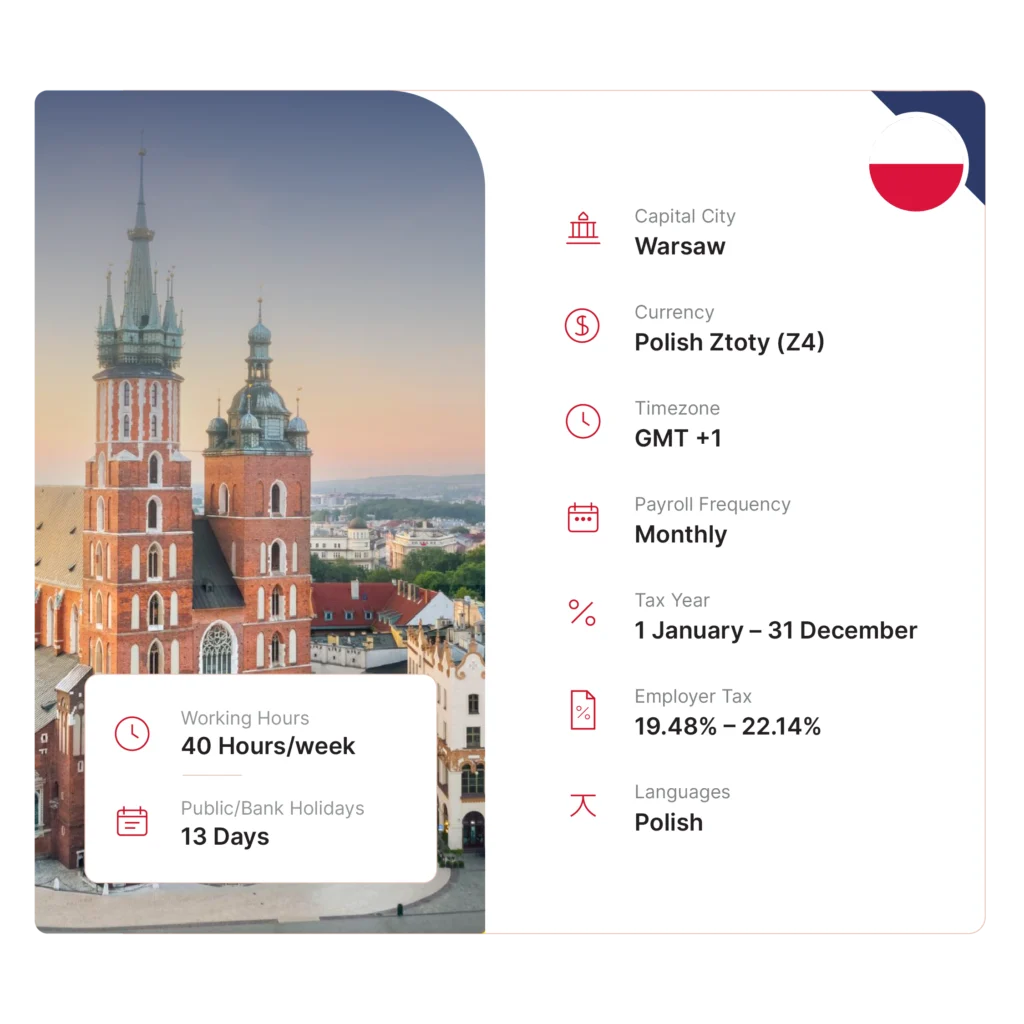
- Public holidays: 13 days
- Sick leave: Up to 182 days of paid sick leave under Polish law
- Maternity leave: 20–37 weeks (based on number of children, with extended duration for parents with five or more children)
- Parental leave: Up to 41 weeks
- Paternity leave: 2 weeks
Working hours and Overtime in Poland
- Standard workweek: 40 hours across five days
- Maximum overtime: 150 hours per year
Overtime compensation:
- 150% of regular pay for standard overtime
- 200% for work on Sundays, holidays, or night shifts
- Additional 20% pay for work performed between 21:00 and 7:00
Taxes
Taxes in Poland
Overtime compensation:
- Employer tax: 19.5% – 28.5%
- Social security: 19.21% – 22.14%
- Employee Capital Plans (PPK): 1.5%
Employee contributions:
- Income tax: 22.7% – 57.1%
- Social security: 13.71%
- Healthcare: 9%
- Solidarity tax: 4% (for income above PLN 1,000,000)
Taxes are withheld directly from the employee’s salary as part of payroll management to ensure compliance with Polish labor laws.
Income tax brackets:
Gross Income | Tax Rate |
|---|---|
Up to PLN 120,000 | 12% |
Above PLN 120,000 | 32% |
All payroll data is managed in compliance with the General Data Protection Regulation (GDPR) to protect sensitive employee information.
Work Permits and Visas in Poland
Visas and work permits in Poland
As an EU member state, Poland allows EU citizens to work without a permit. Most non-EU nationals require both a residence visa and a work permit. The Polish government strictly regulates work permits and employment authorization for foreign nationals, ensuring compliance with local labor laws.
Common permit types include:
- Work Permit Type A: Employment by a Polish company
- Work Permit Type C or E: Intra-company transfers
- Schengen Visa (Type C or D)
- Self-employed or entrepreneur visa
Employees must hold valid authorization before starting work.
Termination in Poland
Termination and Severance in Poland
Employment may end through:
- Mutual agreement
- Termination with notice
- Termination without notice
- Contract expiration
Upon termination, employers must issue a Certificate of Employment and deregister the employee from ZUS.
Severance pay:
- Less than 2 years of service: 1 month’s salary
- 2–8 years: 2 months’ salary
- More than 8 years: 3 months’ salary
Severance is capped at 15 times the statutory minimum wage.
How do Employer of Record providers ensure compliance in Poland?
Employer of Record providers ensure compliance in Poland by operating in strict alignment with Polish employment laws, the Polish Labour Code (Kodeks pracy), and all applicable employment laws and regulations. This includes issuing locally compliant employment contracts, enforcing statutory working hours and overtime rules, and ensuring employees receive at least the national minimum wage. EORs ensure compliance with local labor laws and assume all legal obligations related to employment in Poland.
EORs also handle mandatory registration with the Social Insurance Institution (ZUS), manage employer and employee social security contributions including disability insurance and coverage by the National Health Fund and administer legally required benefits.
Employee benefits may also include private health insurance, which offers supplementary coverage beyond the public system. Additionally, Poland’s state paid university system produces a highly qualified workforce, further supporting employers. EORs maintain compliance with Polish anti-discrimination laws and occupational health and safety standards, reducing legal risk for companies hiring in Poland without a local entity.
Frequently Asked Questions:
How long does it take to set up a company in Poland?
Setting up a company in Poland can take several weeks, depending on the chosen legal structure and the completeness of documentation. While initial registration with local authorities may be completed relatively quickly, additional steps such as opening a Polish bank account, registering for tax and social security purposes, and obtaining any required licenses or permits can extend the timeline.
Ongoing obligations including payroll processing, tax filings, and compliance with evolving labor regulations also require sustained administrative effort and local expertise.
Can I hire independent contractors in Poland?
It is possible to hire independent contractors in Poland, but doing so carries a risk of worker misclassification. If a contractor works primarily or exclusively for one company, follows fixed working hours, or operates under close supervision, Polish authorities may determine that the individual should be classified as an employee.
Misclassification can result in fines, back payment of social contributions, and legal disputes. Companies must carefully structure contractor relationships to ensure they meet Polish legal criteria and do not resemble standard employment arrangements.
Best Employer of Record providers in Poland
Several Employer of Record providers operate in Poland, offering solutions for companies that want to hire locally without establishing a legal entity. These providers differ in terms of geographic coverage, entity ownership, technology platforms, and support models.
Among these options, companies seeking a compliant and scalable hiring solution often choose PamGro, which enables businesses to hire employees in Poland while managing payroll, contracts, and compliance through a single, centralized system.
Hire the Best Talent, Anywhere
Onboard and pay top employees and contractors globally, without worrying about entities or compliance.
Get Started