

Your guide to hiring employees in Germany, covering employment and labor laws, payroll, benefits, onboarding and taxes. You can also manage and pay your contractors in Germany through PamGro.

Hire in Germany with ease, our experts handle employment and compliance for you.
An Employer of Record (EOR) in Germany is the legal employer of a worker and must hold a valid AUG licence (Arbeitnehmerüberlassungsgesetz licence) to operate compliantly. Under German law, any company that employs workers on behalf of another organization is classified as a personnel leasing provider and must be authorized accordingly. The EOR assumes full responsibility for all employment-related compliance in Germany, including payroll processing, tax withholding, statutory benefits, and employment contract administration, while the client company directs the employee’s day-to-day work.
As the licensed legal employer, the AUG licence holder is responsible for ensuring employment complies with German labor laws, processing local payroll, filing employment-related taxes and returns, issuing compliant payslips, and distributing salary payments to employees. This structure transfers employment liability from the client company to the EOR and significantly reduces regulatory and misclassification risk.
Hiring through an Employer of Record in Germany follows a structured process designed to ensure compliance while minimizing setup time and operational overhead.
Whether to hire through an EOR or establish your own German entity depends on your company’s resources, growth plans, and appetite for administrative complexity.
Setting up a legal entity in Germany
Establishing a German entity typically requires registration with local authorities, opening a German bank account, and working with legal and tax advisors to ensure compliance. Employers must complete a notary appointment, obtain approval from the Chamber of Commerce (IHK), and register the company in the commercial register (Handelsregister) before payroll can begin. This process can take several weeks or longer.
Hiring through a German Employer of Record
An EOR acts as the legal employer on your behalf, eliminating the need to form a local entity. The EOR handles employment contracts, payroll, tax withholding, benefits administration, and compliance with German labor laws, allowing companies to hire employees in Germany quickly and compliantly.
Choosing the right EOR provider depends on local expertise, compliance capabilities, and operational transparency. Compliance expertise is crucial for navigating Czech labor laws and ensuring your business remains fully compliant with local regulations.
Providers that own their Czech legal entity typically offer faster onboarding, fewer compliance risks, and a smoother employee experience compared to those relying on third-party partners. Transparent pricing, in-country legal support, dedicated account management, and robust workforce management solutions are also key indicators of a reliable EOR.
Using an Employer of Record allows companies to hire employees in Germany without setting up a local entity, opening a bank account, or managing complex payroll and compliance processes. Because the EOR acts as the legal employer, it assumes responsibility for compliance with German labor and tax laws.
An experienced EOR manages country-specific wages and benefits, payroll deductions, termination procedures, employee classification, holiday entitlements, and data protection requirements. This enables companies to scale their German workforce efficiently while reducing legal and operational risk.
Employer of Record pricing in Germany typically follows one of two models: a fixed monthly fee per employee or a percentage of payroll plus applicable taxes. Additional costs may include onboarding fees, administrative charges, or fees for optional services.
In Germany, employer statutory contributions generally amount to approximately 20–22% of gross salary, covering social security and insurance obligations. EOR service fees commonly range from €300 to €600 per employee per month, depending on the provider and scope of services.
The EOR model is built for companies that want the benefits of hiring in Sweden without navigating the legal complexities of Swedish labour law. An Employer of Record (EOR) like PamGro takes on both administrative responsibilities and employment responsibilities on behalf of the client, managing payroll, taxes, benefits, and onboarding. Sweden’s regulatory environment makes structured, compliant employment essential.
With a sweden employer of record like PamGro, the employment structure works like this:

Employment relationships in Germany are governed by employee-protective labor laws. While a written contract is not mandatory to establish employment, employers must provide a written summary of key employment terms within one month of the employee’s start date under the German Documentation Act (Nachweisgesetz).
Employment contracts generally cover:
Fixed-term contracts must be in writing to be legally valid. If a fixed-term arrangement is agreed verbally, the employment is automatically treated as indefinite. When hiring through an employer of record Germany, the EOR issues a locally compliant employment contract and assumes legal employer responsibilities.
The German Civil Code covers many employment regulations, but labor laws are also contained within several acts such as the:
Each of these acts outlines different protections for employees. Additionally, there are trade unions and collective bargaining agreements that can revise labor laws.
Germany enforces a nationwide statutory minimum wage applicable to nearly all employees. The current minimum wage is €13.90 per hour, though higher rates may apply under collective bargaining agreements in certain industries.
Compliance is strictly monitored, and violations can lead to significant penalties. A Germany employer of record ensures wages align with statutory and sector-specific requirements.
Working time in Germany is regulated by the Working Time Act (Arbeitszeitgesetz). The standard working day is 8 hours, extendable to 10 hours provided the average remains within legal limits. The maximum workweek is capped at 48 hours.
Employees are entitled to mandatory rest breaks and daily rest periods. Sunday and public holiday work is generally prohibited except in specific sectors. An EOR Germany ensures working hour limits are correctly reflected in contracts and payroll practices.
Overtime compensation in Germany is regulated by employment contracts, collective bargaining agreements, and labor law principles. Employees are commonly entitled to overtime pay at around 25% above their regular hourly rate.
Overtime worked on weekends or public holidays may be compensated at higher rates, including time-and-a-half or double pay, depending on contractual or collective agreements. Employers must also ensure compliance with working-time limits and rest-period requirements to avoid penalties.
As of 2025, the average gross annual salary in Germany is approximately €50,250. Compensation varies significantly by experience, sector, and location. Industries such as IT, engineering, and finance typically pay above-average wages, while major cities like Munich, Frankfurt, and Hamburg offer higher salaries than smaller towns or eastern regions.
Germany’s economy is currently experiencing slow growth with stabilizing inflation (~2%), which may moderate salary increases in the short term.
★ Pension: 9.3%
★ Health insurance: 7.3%+1.45% additional contribution (assuming a 2.9% Zusatzbeitrag fund)
★ Long-term care: 1.8%
★ Unemployment insurance: 1.3%
★ Pension: 9.3%
★ Health insurance: 7.3%+1.45% additional contribution (assuming a 2.9% Zusatzbeitrag fund)
★ Long-term care: 0.8%-2.4%
★ Unemployment insurance: 1.3%
| Rate | Single Band |
| 0% | Up to €12,096 |
| 14-42% | €12,097 – €68,429 |
| 42% | €68,430 – €277,825 |
| 45% | Over €277,825 |
EU, EEA, and Swiss nationals may work in Germany without restrictions. Non-EU nationals must hold a valid residence permit and work authorization before employment begins. Common permits include the EU Blue Card and skilled worker visas tied to qualification and salary thresholds.
Employers are legally required to verify an employee’s right to work prior to onboarding. A Germany EOR manages work authorization checks and ensures employment begins only after valid permits are confirmed.
20-24 working days +9 public holidays (some states have extra public holidays)
6 Weeks
14 weeks (six weeks prior and eight weeks following childbirth)
12-14 months
In Germany, employees are entitled to a statutory minimum of 20 days of paid vacation per year for a standard 5-day workweek, or 24 days for a 6-day workweek. In practice, most full-time employees receive 25–30 days of paid annual leave, as this is the market standard across industries. Paid vacation is separate from public holidays and sick leave and must be granted in addition to those entitlements.
German employees are entitled to up to six weeks of sick leave at full pay per illness, provided a medical certificate is submitted. While certificates are commonly required after three days of absence, employers are legally allowed to request one from the first day. After the six-week period, employees receive statutory sickness benefits (Krankengeld) from their public health insurance, generally equal to 70% of gross salary, capped at 90% of net pay, and subject to social security ceilings.
Germany offers strong protections for new parents. Pregnant employees are entitled to fully paid maternity leave (Mutterschutz) for six weeks before birth and eight weeks after birth, extended to 12 weeks in cases of premature or multiple births. Following maternity leave, either parent may take parental leave (Elternzeit) until the child turns three. During this period, parents may work part-time for up to 32 hours per week.
Eligible parents can also receive Elterngeld, a government-funded allowance that replaces part of their income for up to 14 months.
Germany observes 9 national public holidays, with additional holidays varying by federal state:
New Year’s Day (Jan. 1)
Good Friday
Easter Monday
Labour Day (May 1)
Ascension Day
Whit Monday
Day of German Unity (Oct. 3)
Christmas Day (Dec. 25)
Second Day of Christmas (Dec. 26)
Notice periods range from 4 weeks to 7 months, depending on tenure. Severance pay is not required by law but is commonly negotiated.
Employee onboarding through an EOR in Czechia typically takes one to two working days once all required information has been submitted. It is essential that onboarding processes strictly adhere to Czech employment regulations to ensure legal compliance from day one. For non-EU nationals, right-to-work checks may add several additional days. Payroll cut-off dates, often around the 10th of each month, can also affect the employee’s official start date.
Pre-employment medical checks may be required in certain roles, though remote employees are generally exempt unless specific occupational health risks apply.
Companies choose PamGro in Germany because it combines deep operational experience with strict local compliance and transparent pricing in one of Europe’s most regulated employment markets.
With 18+ years of experience, 13 global entities, and over $150M in payroll processed, PamGro ensures employees are hired under fully compliant German contracts, correctly classified, and protected through robust IP safeguards and GDPR-aligned data privacy standards.
As an AUG-licensed Employer of Record, PamGro is legally authorized to employ workers on behalf of foreign companies in Germany and assumes responsibility for payroll, taxes, statutory filings, and employment liability.
PamGro ensures all hiring complies with AUG regulations, manages long-term hiring strategies beyond the 18-month AUG cap where needed, and mitigates permanent establishment risk—while also enabling companies to scale hiring across Germany and multiple countries through a single, predictable, flat-fee platform.
Setting up a company in Germany typically takes several weeks, depending on the legal structure and readiness of documentation. In addition to registration, employers must complete banking, tax, and social security registrations before payroll can begin.
Hiring independent contractors in Germany is permitted, but misclassification risks are high. Contractors who work primarily for one company or operate under close supervision may be reclassified as employees under German law, which can result in penalties and retroactive social security contributions.
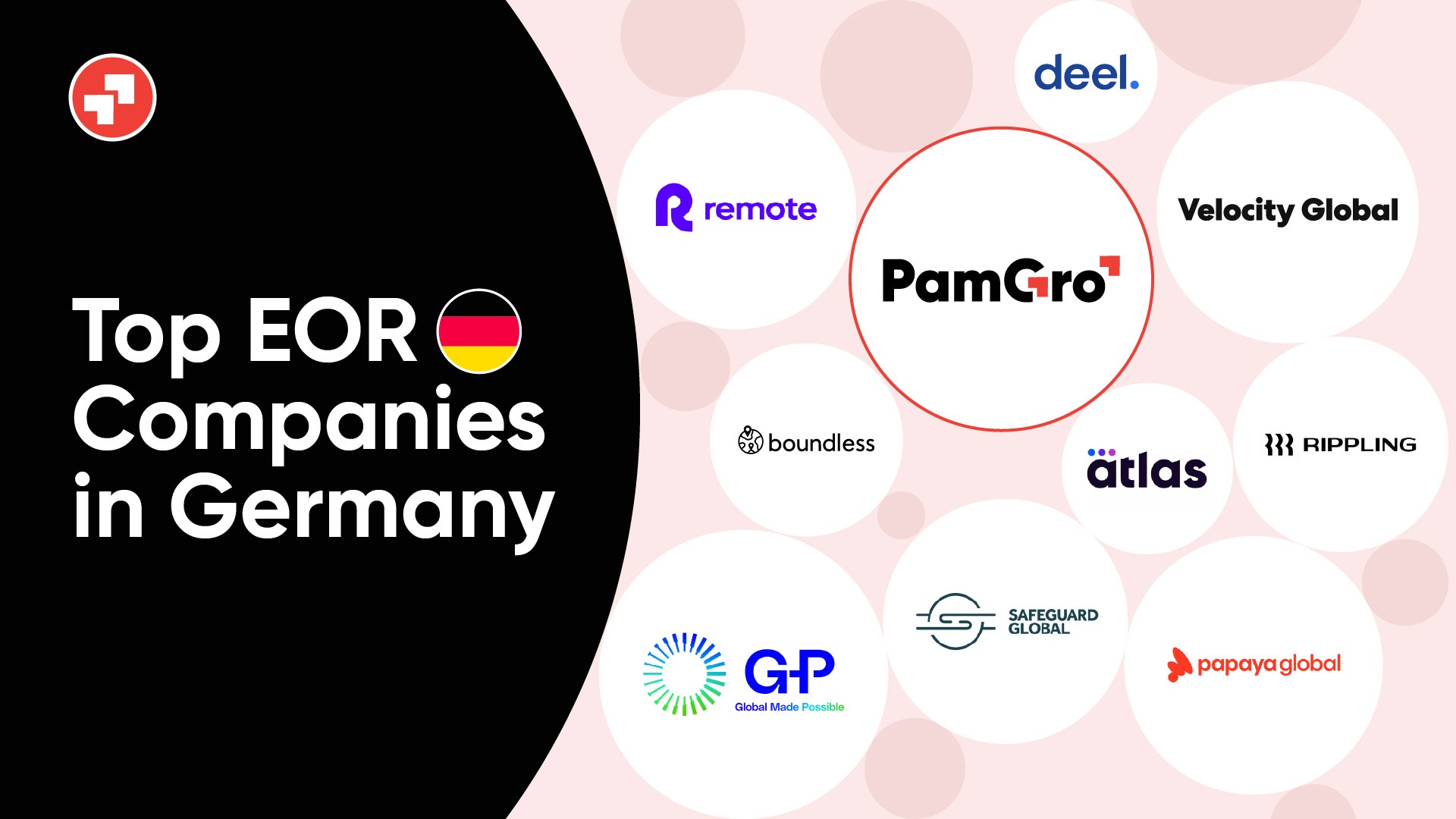
Several Employer of Record providers support US companies hiring employees in Germany, including G-P, Remote, Papaya Global, and Omnipresent. These providers enable US businesses to employ German workers without establishing a local entity and offer varying levels of payroll automation, compliance support, and in-country expertise.
Among them, PamGro differentiates itself through AUG-licensed employment, strong local compliance depth, transparent pricing, and a focus on reducing permanent establishment and misclassification risk for US companies entering or scaling in Germany.
Platforms such as G-P, Remote, Papaya Global, and Omnipresent allow companies to hire remote employees in Germany through an Employer of Record model, providing entity-backed employment, payroll processing in euros, and compliance with German labor and tax laws.
When choosing among these platforms, companies typically evaluate local entity ownership, AUG licence coverage, compliance expertise, pricing transparency, and support quality. Based on these criteria, PamGro is often selected as a leading platform for hiring remote employees in Germany due to its robust compliance foundation, predictable flat-fee pricing, and ability to manage contracts, payroll, and statutory obligations through a single, centralized system.